Showing posts with label Bergson. Show all posts

8/17/11

Hammer to fall


Hammer throw quite accurately describes what reterritorialization is about. The centrifugal (Latin: fleeing the centre) vertigo of the hammer might appear as a straightforward deterritorialization, but is actually dominated by the ego-boosting, centripetal (Latin: seeking the centre), effort of the athlete. Who is the centre of it all? A "me, me, me!" that eventually loses it all. Whereas the javelin thrower produces a centre-fleeing line.

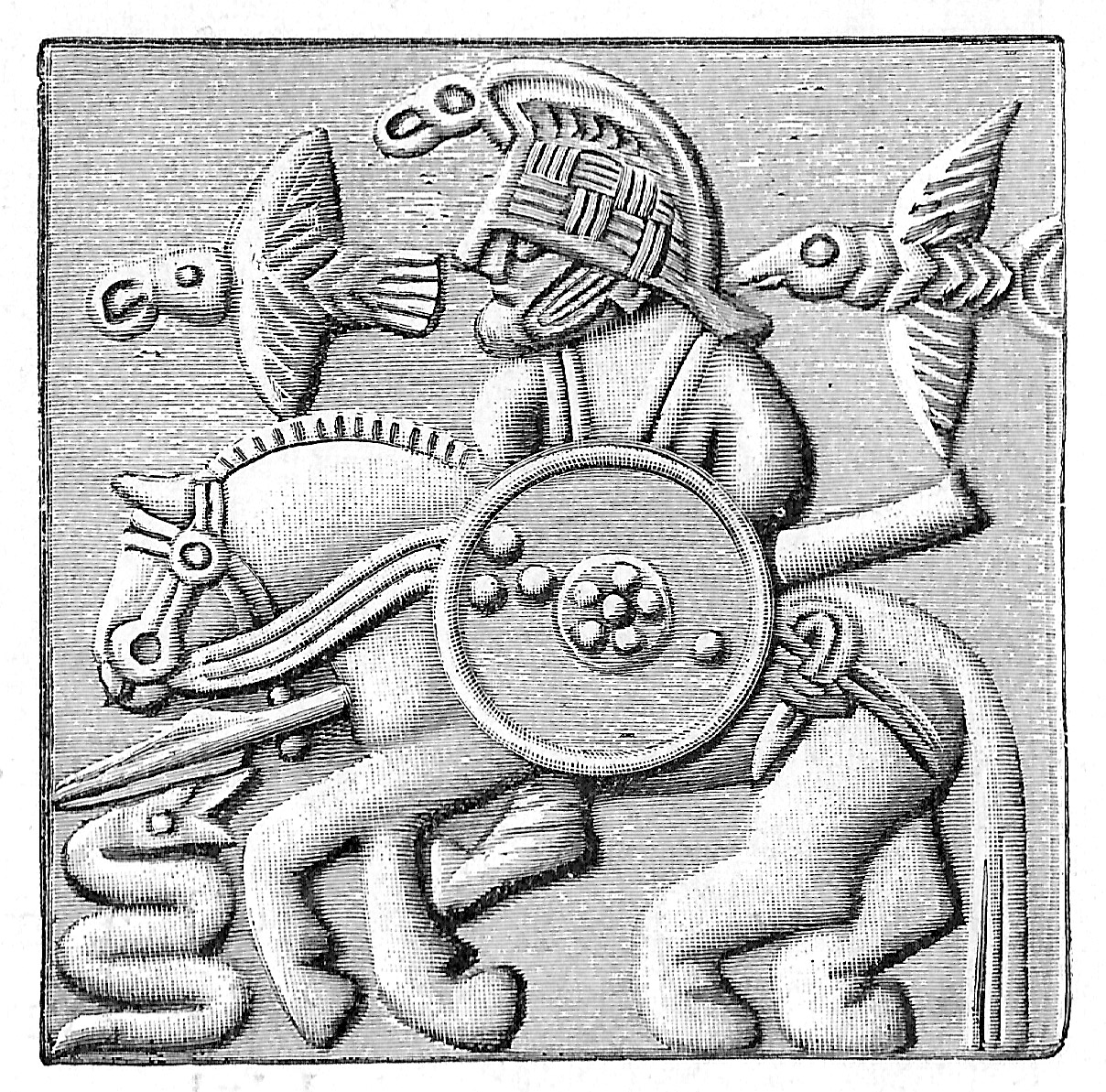
Let us now pay a visit to the early hurlers in the Norse mythology, and compare the two precious weapons of the king of the gods, the one-eyed Odin, and his son, the thunder-deity Thor.

The trickster god in Norse mythology, Loki, happened to accomplish the task of fooling the dwarven master-smiths to give their most wonderful creations to the foremost of the Æsir. The fact that Thor was more impressed with his hammer, than Odin was with his spear, is a precursor of the reign of (re)territorialization as a pivotal organizational and metaphysical rationale in the modern constitution.

No wonder that the reterritorializations of Mjolnir, Thor’s hammer-cum-boomerang (hammerang?), appear as more useful and utilizable than the one possible deterritorialization of Gungnir, Odin’s all-piercing spear, that constantly increases the distance between itself and its thrower. Gravity and Celerity.

But the age of the hammer has come to an end. The gravity of the iconoclast's hammer will be substituted, perhaps with the celerity of the javelin - the maker of holey space.

Perhaps we are now entering the age of the javelin, in which:

we have only got one shot,

we are one-eyed,

we must use our intuition.


2/15/11

Holey diver

Holy Diver
You've been down too long in the midnight sea
Oh what's becoming of me - DIO


Hill Taylor stunned the world by breaking the world-record in backstroke 50 m in a minor championship. His performance was also a baptism, in which the name dolphin-man was lent to him.

Dolphin-man is the fastest in the contest, and, with regards to the distance backstroke 50 m, even in the world. But he cannot win, and he knows that. It all depends on his maneuvre of preference, the dolphin-kick. The excellence by which he wields this powerful weapon is the key to his total domination. This move is not essentially illegitimate in backstroke, only so when it emerges in certain proportions. A swimmer must return to air after fifteen metres, lest he's to be disqualified.


Consequently, backstroke 50 m should be named "backstroke more than or equal to 35 to less than or equal to 50 m". Given this, one cannot practically be a record-holder in backstroke 50 m! If you on the one-hand swim using regular backstrokes (think paddle-wheels on steamboats), your opponents will leave you behind as fast as dolphins ward off a shark attack. On the other hand, if you, like the dolphin-man, multiplicate the efficient dolphin-kick, your result is not qualified. That he aggregates a legitimate gesture at least qualifies him as minor athlete.

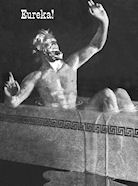
Practically, no one can be said to hold the world-record in this aquatic event, since what's measured is fuzzy. A fuzziness whose depth dolphin-man delves into. Almost like what D&G hold as the ideal stance in minor science, it is both the "backstrokeness" and "50 metresness" of backstroke 50 m that dolphin-man examines in this race. Albeit in a bigger bathtub, and with an euresqueeeeka, dolphin-man's performance appears as an Archimedean event.


Reading the work of Peter Sloterdijk incites us to ask strange questions. For example, can man become an aquatic being again? Is it possible for a human being to dive into the water not to drown there but to take up with dolphins and mermaids? Are we able to switch elements like this? (...) Sloterdijk's focus on the elements air and water is meant to counteract the age-old philosophical tendency to prioritise earth and fire. (...) It is true, philosophy started with a notorious claim about water. Thales of Miletus (624-545 BC) argued that it was no less than the basic principle (arche) of everything, but subsequent philosophers have done everything to stash away Thales's proposition. How, after all, could one base the world on something fluid? So, philosophy forgot about its own beginnings and became a dry exercise. (...) Almost all anthropology is suffering from a mono-elementary bias. It interprets us as creatures who in the end can only exist in one element, that is to say, on the mainland, in the so-called real. - Rene ten Bos, Towards an amphibious antropology, Environment and Planning D: Society and Space 2009, volume 27, pages 73-86.
The dolphin-man proves to be a fine specimen of the variety of conceptual athletes, by way of which the poet John Keats demonstrates the essence of poetry for his adept-lover Fanny Brawne in the movie Bright Star:
A poem needs understanding through the senses. The point of diving in a lake is not immediately to swim to the shore; it's to be in the lake, to luxuriate in the sensation of water. You do not work the lake out. It is an experience beyond thought. Poetry soothes and emboldens the soul to accept mystery.
Poetry (poeisis) is equivalent with pro-duction (Agamben), invention (Serres), and virtuosity (Virno). Poeisis just happens and is seldom an effect of a planned scheme; contrary to praxis, which contains in itself the goal, the implementation, and the expected outcome of an act. But doesn't dolphin-man, contrary to Keats' poet-swimmer, immediately swim to the other shore? Isn't dolphin-man rather an example of a teleological thinking devoid of all means and process? No. He demonstrates that speed is of the essence, not in order to win, but in order to be able to discern problems just before they gel. To gel is the same as being devoured by that great monstrosity that strives to capture all lines of flight: spectacle. Investigate into fuzziness instead! Dolphin-man will lead us past Leviathan.

During movement, the dolphin-man never leaves the water, which is treason against "the criterion of due humanness in sport".* It's mandatory that the body backstroke-swimmer breaks the surface at least once from underneath. In backstroke man must proof he's a mono-elemental entity by breathing once in a while. Dolphin-man doesn't. Beneath waves events are too furtive to be (made) spectacular.


*This concept will need more unfolding than the initial one, carried out here. "The criterion of due humanness in sport" is a concept that relies on the hypothesis that sport, in order to be sport, must include Latourian-flavoured "trials of humanness". The human factor must be guaranteed and legitimized in sports. When someone runs fast in track and field contests, wind speed must be accounted for in order for the results to be reliable. Testing for doping is legio in contemporary sports. That illegal substances mustn't be found in the athletic body is another example of the criterion of due humanness in sport.

On the one hand, sport is a perfect inversion of the laboratory in which humanness must be quashed, and in which substances are everything. On the other hand, sport is only partly a perfect inversion of the laboratory (at least in Latour's ideal-type of the same): whereas objective measure is celebrated in both laboratories and sports, the former purify nonhumanity from humanness, while the latter purify humanity from nonhumanness.

2/3/11

The rules of the game: Science and Sport

Yesterday, an open seminar about publishing strategies, and differences between "the two cultures" (natural and human science) was held in Malmö University. Janken Myrdal, a professor in agricultural history, gave the keynote speech, which was followed by a discussion between invited guests and the auditorium. The panel consisted of heads of universities, deans from cross-disciplinary faculties and bibliometricians.

Myrdal argued, that, due to the prevailing system of research funding based on citation index and the like, it is demanded that natural and human sciences should endeavour for increased confluence, regarding methodology and terminology. As a historian, his main focus was to safeguard the particular publishing style of social science, with long books, and rich personally flavoured use of language. This kind of title does not bibliometrically render the same impact as a peer reviewed article in a renowned journal, which is the most prominent way to publish in contemporary academia.The debate was rich, inspiring, and of the kind, that one expects to meet in university.


Janken Myrdal - Spelets regler from Malmö University on Vimeo.

I spoke with Myrdal in the break, and asked him about his frequent use of sport metaphors. ("Natural scientists are doped, they publish too much"; "Basing research-fundings on citation index is like applying the rules of soccer in handball: the handballer cum social scientist wouldn't stand a chance due to her repeated hand-fouls."; "Science, like sport, is a way of demonstrating muscle-capacity in an international context"; "The B-team (of academia) writes the textbooks, while the stars write peer review articles"). He replied that although he wasn't interested in sports per se, he was fascinated of how overt the core rationale of sports is, ie the agenda of elimination, exclusion, and ranking.

Evidently, sport, as a metaphorical resource, has a beckoning naturalness to both clergy and laity. The use of sport in social science and philosophy as a verifying material in demonstrations is of particular interest to me.

Massumi talks of subjectivity with examples from soccer; Serres talks of relations, objects and subjects with an example from rugby; Elias & Dunning construct figurational sociology from an analysis of tension-equilibrium in association football; Pierre Levy explores communality and informatics applying the metaphor of soccer, and so on. Not to mention all agile conceptual personae in contin(g)ental philosophy (Nietzsche, Deleuze, Badiou, Bergson, etc).

Perhaps, the distinction between Apodeixis (a mathematical, or at least rigorous, demonstration) and Epideixis (demonstration by a flourish of words) is apt to apply here. Athletes are often stripped of their subjective dimension in contests, and thereby resemble the mute, reliable objects of nature, which are discovered/produced in laboratories. Sport, therefore, could be regarded as a pseudo-laboratory for social science.

Social science's long tradition of feeling lesser than its natural sibling emanates in part from its inability to establish demonstrations as rigorous as in the laboratory (Apodeixis). Epideixis, the flourish of words -- so dear, as a demonstrational utensil, to sophists -- is partly shunned by social science, since it emphasises the ephemerality of subjectivity and humanity. The human, all too human, dimensions of society (tautology, or? Ask Latour) are what create problems with validity in social science and the humanities.

Sport stands forth as an answer to the alleged softness of chattering human statements, since demonstrations most often are mute, but still figurationally and socially relevant. The objective performance by athletes bridges the gap between humanitas (man as a cultural and societal creature) and homininae (man as biological species).

Social science finds its apodeixis in the world of sports. Now there is line of thought I would like to develop!


11/2/10

The art of tracing VIII: I move, therefore I think


Who was this 'I'?
It is something everyone knows, unemotionally and as a matter of fact. You only have to pass through a small opening,a blocked corridor, to swing over a handrail or on a balcony high enough to provoke vertigo, for the body to become alert. The body knows by itself how to say I. It knows to what extent I am on this side of the bar, and when I am outside. It judges deviations from normal balance, immediately regulates them and knows just how far to go, or not to go. Coenaesthesia says I by itself. It knows that I am inside, it knows when I am freeing myself. This internal sense proclaims, calls, announces, sometimes howls the I like a wounded animal.
(Michel Serres, The Five Senses, p. 19).

Like the body, the mind needs movement, especially subtle and complex movement. (Michel Serres and Bruno Latour, Conversations, p. 107).

The cartesian cogito has tantalized metaphysicists for quite some time now. To trace is to investigate into what the 'I' may be(come). 'Metaphysics begins with, and is conditioned by, gymnastics', Serres tells us. To careen is to enable thinking. Speed is not the product, but the method. The multitude of conceptual athletes and gymnasts, that has emerged from contin(g)ental philosophers like Nietzsche, Deleuze, Bergson, Badiou, and Serres, bears witness to that.

As Brian Massumi and Erin Manning, by way of Bergson, Whitehead, and Deleuze, inform us: to move is to elude being caught in nodes of pre-formed identities. The 'I' is the sweet uncertainty that is produced when one traces. I trace therefore I think.


10/24/10

The art of tracing VII: Monster Hug (avoid falling down)


Walking and perceiving, preferrably optically, stand out as the main acts of flaneurhood. Many testimonies bear witness to the flaneur as being one of urbanity's most well-known psychosocial types: Baudelaire, Benjamin, Simmel, de Certeau, Debord etc. The flaneur is a rather delicate and sometimes distant character that strolls through urban realms; Henry Miller creating a smooth space while loitering around in Brooklyn, as Deleuze and Guattari remind us.

In his conceptualization of parkour, Michael Atkinson timely interprets the traceur as a late-modern flaneur. While the modern flaneur was 'sketching' a space for himself (yes, unfortunately, this is just another persona based on an initially, and still hegemonically, male praxis), in which he could 'read' the city, Atkinson conceptualizes the late-modern variety as being capable of Heideriddean deconstruction. The void between houses, sous rature, becomes a void.


avoid falling down

It's inadequate to conceive of the opposite sides of a void as incommensurable, but it's necessary to stress that there is a gap, and that it takes a leap of faith to cross it. Association. Tracing is a micropolitically informed sociology. Life and live in HypheNation. Furthermore, concerning the flaneurie of traceurie, it seems that Deleuze and Guattari's distinction between smooth and striated space could enrich Atkinson's attempt to grasp parkour.

In sketching (tracing) space, the flaneur uses only the utmost tip of his body-brush: the soles of his shoes. The rest of the body is busy with an array of repetitive bodily idiosyncracies, such as smoking, walking casually, nodding, and tipping his hat at attractive and interesting passersby. The difference he makes is not to be found in these simple schemata, in this endless repetition, but in his interpretetive gaze. The optic reading of the city is the prime power of flaneurie. Compared with that, the bipedal itinerancy and meanderings of flaneurs appear as quite lame performances.

Deleuze and Guattari label the city "the striated space, par excellence", and by striation they mean the creation of channeled and hierarchical space, so that movement, in it, is rendered predictable. Striation, as the cybernetics of displacement, is the ordering of identities and positions onto grid-like fields, that are easily surveyed. In striated space, vision and optics therefore have a primacy. This of course relates to Foucauldian panopticon. One might even assert, that, as cities grew more and more entangled, more rhizomatic, and therefore more hard to overview, the proliferation of flaneurs served as a "necessary" distribution of surveillance. Big brother tips his hat at you. Male Gaze, and all that.

The traceur puts a different approach on display as he connects haptically, and not primarily optically, with the the city. The optic primacy of striated space, in smooth space, is inversed to a haptic primacy. A heightened hapticity, is the tactilization of (all) the senses. Although a loosely standardized and sketchy one, the repertoire of movements of traceurs often bear names that are lend from different agile species in the animal kingdom, such as cats and monkeys. And this should not primarily, as Michael Ferrari's analysis might imply, be interpreted as a search for an alleged pristine and savage nature of mankind. Rather, the quadropedal style of traceurs is functional-experimental. In parkour one does not mimic a animal, one is, as Deleuze and Guattari would have it, becoming-animal. One dialect of Agamben's gestural communication in the 'coming community' could definitely be taught by traceurs.


Being a late-modern flaneur, the traceur grasps and embraces his surroundings, rather than putting them on the hermeneutical treadmill. As a philosophical stance, then, tracing is kin to the musings of Bergson, when he -- by way of intuition, rather than through conceptual clarity -- attempts to melt into the phenomena under investigation. Whereas the flaneur perceived and interpreted the monstrosities of urbanism, the traceur conceives the city, in all its denotations; demonstration. Monstrare means 'to show', and -- although tracing might be perceived by pedestrians (modern flaneurs perhaps) as a spectacle -- a show is primarily seen, in that it evokes vision. Monsters are seldom felt; the moment when the monster will reveal itself is always the climax (equivalent to the climax when it is defeated). Once in a while even a monster needs a hug.

And that, is what traceurs do: hug monsters.