Showing posts with label Agamben. Show all posts

8/18/11

Trials of the Leviathan: ret(errito)rial(ization)s or det(errito)rial(ization)s?

No, I don't even know your name, it doesn't matter.
You're my experimental game, just human nature.
-Katy Perry

Movement and territory

Movement is always a series of trials. The properties of actors are constantly being measured and exchanged during displacement. “Bruises bigger than dinner-plates” (The Smiths). Grinded concrete (Borden, 2001; Bäckström, 2005) – inverted statue (Serres; Jonasson, 2011). The movement-trial is necessarily always about deterritorialization and reterritorialization. Letting go and glueing; scattering and gathering; Slytherin and Gryffindor (Rowling).

Deterritorialization is literally something firm and dry in the process of being destabilized. Words leaving the mouth. A moth spreading out its wings and taking off. Movement is the message being translated, even the message of translation itself. Voiced by guides. A less known meaning of translation is betrayal. Betrayal in motion. Lost in translation. In medias res.

Concerning spatiality, temporality, and conditions for participating actors, trials in sport are rather elaborated and refined. The trials in sport aim to purify human action both with the help from and in relation to nonhuman actors. The outcome must result in the reconstruction and reproduction of universal humanness. In the same way Latour understands the universality of science, universal should here be understood as universal within its own network. Since both these networks, science and sport, are rather lengthy, universality in them are perceived as fully transcendent. A world record is a world record, and a scientific finding published in Science is a gift to the whole globe.

Without its deterritorializations, sport would be literally lame. (The extreme ability of athletes’ bodies in fact bears a heavy load of guilt regarding the stigma of disabled bodies). The appealing turbulence of sporting collectives – Serres’s ‘glorious uncertainty’ and Loland’s ‘sweet tension’ – is due to deterritorialization.

But sport without proper reterritorializations would only result in people throwing themselves out from, or cars crashing with, cliffs. Medieval folk-football was in this aspect poorly reterritorialized. Sports that are described as risk, lifestyle, adventure, and extreme are characterized by a high degree of deterritorialization. What kind of territory, then, is it that is confirmed and accumulated by reterritorialization in sport?

Sport reterritorializes on the modernist settlement, the abode of the tribe known as the moderns. Their most characteristic feature is that they make an absolute distinction between nature and society, in their story of themselves. At the same time, they let actors from both these ‘satellites’ (Latour), intermingle and proliferate, wildly and freely. A State, a Hobbesian Leviathan (Deleuze & Guattari, 1987), such as the modernist settlement is based on dichotomous arrangements like these. Nature and society is an overarching metaphysical couple in modernity, but time is also divided into a before and after (enlightenment). Revolution. Following Deleuze and Guattari (1987), such dichotomies and binaries are abundant in the ‘State’, i.e. networks like the modernist settlement. In sport, this partitioning is effectuated in the reinforcing of age, weight, and sex.

Hobbes’ social contract and naked apes

So why has it in the modernist settlement been so crucial to construct pure forms of human, humanity, culture and society? This is a highly political question, and the administration and implementation of it have had wide implications on all collectives since the enlightenment. With concepts such as ‘contract’, ‘citizen’, ‘representation’, ‘sovereign’, ‘power’, and ‘society’, British philosopher Thomas Hobbes systematized a nomenclature, whose seal modern social science still bear. The erecting of a purely human collective, the Leviathan, was Hobbes’s solution to the religious conflicts that haunted Europe at the time, and had done so for quite long.

All local, contingent, and singular interpretations of the Bible were deemed dangerous by Hobbes. Inventive readings of the book could be harmful if they led to an exegesis that admitted the existence of immaterial, spiritual, yet potent entities outside the perimeter of State surveillance. Spectres and ghosts were all to be exorcised in one single stroke, that of inaugurating the Sovereign. If all human actors agreed on who was to represent them, the State would not only get a representative of the people, but also a highly legitimate spokesman for the divine realm. Chosen by both deity and laity, the Sovereign controlled both the earth and the heavens, but in a perfectly just way. For, who was this regent? Not just some despot, or tawdry usurper, but the very people itself, incarnated in one person.

This political strike of genius would ward off all that wasn’t human in collectives. This is how the discourse of that encampment of naked apes, today living under the name of society, came to be. The encapsuling of a society meant that nude monkeys henceforth established their own parks and Zoos (Sloterdijk, ten Bos, Agamben) in a way that protected them, not only from spirits, but from falling back into the violent ‘natural state’ (like that of folk-football). One could easily see why this neat little arrangement was worth to cherish, and to keep safe and sound.

Retrials and detrials

So, every reterritorialization acts to reinforce all these divisions. We can therefore in sport perhaps speak of retrials which repeat, accumulate, gel, and glue the Leviathan; macropolitically, in reestablishing power-relations between social categories, and, micropolitically, by purifying a universal humanity from nonhumanity.

Conversely, we could talk about, detrials, in which the outcome is more uncertain. Save for mass-production of losers and composition of a universal humanity, sweet tension of uncertainty of outcome is precisely sport's most decisive output.

Detrial and retrial are perfectly balanced in sport. The uncertainty of outcome in sport (detrial) feeds the need of seeing the humanity as a multitude of volatile and singular free-willed subjects, while the reproduction of social categories, their internal power-relations, and the controlled participation of objects in sport (retrial), vanguard the abode of naked apes (gymnos meaning naked in greek). This illustrates the shift, Latour claims that moderns do, conveniently and naturally, between society as soft (detrial), and hard (retrial).

That is why sport, despite its experimental endeavors to find out what bodies (anybody) could do, never jeopardizes the universal identity of humanity that it promotes.

2/15/11

Holey diver

Holy Diver
You've been down too long in the midnight sea
Oh what's becoming of me - DIO


Hill Taylor stunned the world by breaking the world-record in backstroke 50 m in a minor championship. His performance was also a baptism, in which the name dolphin-man was lent to him.

Dolphin-man is the fastest in the contest, and, with regards to the distance backstroke 50 m, even in the world. But he cannot win, and he knows that. It all depends on his maneuvre of preference, the dolphin-kick. The excellence by which he wields this powerful weapon is the key to his total domination. This move is not essentially illegitimate in backstroke, only so when it emerges in certain proportions. A swimmer must return to air after fifteen metres, lest he's to be disqualified.


Consequently, backstroke 50 m should be named "backstroke more than or equal to 35 to less than or equal to 50 m". Given this, one cannot practically be a record-holder in backstroke 50 m! If you on the one-hand swim using regular backstrokes (think paddle-wheels on steamboats), your opponents will leave you behind as fast as dolphins ward off a shark attack. On the other hand, if you, like the dolphin-man, multiplicate the efficient dolphin-kick, your result is not qualified. That he aggregates a legitimate gesture at least qualifies him as minor athlete.

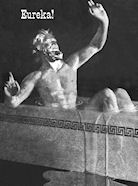
Practically, no one can be said to hold the world-record in this aquatic event, since what's measured is fuzzy. A fuzziness whose depth dolphin-man delves into. Almost like what D&G hold as the ideal stance in minor science, it is both the "backstrokeness" and "50 metresness" of backstroke 50 m that dolphin-man examines in this race. Albeit in a bigger bathtub, and with an euresqueeeeka, dolphin-man's performance appears as an Archimedean event.


Reading the work of Peter Sloterdijk incites us to ask strange questions. For example, can man become an aquatic being again? Is it possible for a human being to dive into the water not to drown there but to take up with dolphins and mermaids? Are we able to switch elements like this? (...) Sloterdijk's focus on the elements air and water is meant to counteract the age-old philosophical tendency to prioritise earth and fire. (...) It is true, philosophy started with a notorious claim about water. Thales of Miletus (624-545 BC) argued that it was no less than the basic principle (arche) of everything, but subsequent philosophers have done everything to stash away Thales's proposition. How, after all, could one base the world on something fluid? So, philosophy forgot about its own beginnings and became a dry exercise. (...) Almost all anthropology is suffering from a mono-elementary bias. It interprets us as creatures who in the end can only exist in one element, that is to say, on the mainland, in the so-called real. - Rene ten Bos, Towards an amphibious antropology, Environment and Planning D: Society and Space 2009, volume 27, pages 73-86.
The dolphin-man proves to be a fine specimen of the variety of conceptual athletes, by way of which the poet John Keats demonstrates the essence of poetry for his adept-lover Fanny Brawne in the movie Bright Star:
A poem needs understanding through the senses. The point of diving in a lake is not immediately to swim to the shore; it's to be in the lake, to luxuriate in the sensation of water. You do not work the lake out. It is an experience beyond thought. Poetry soothes and emboldens the soul to accept mystery.
Poetry (poeisis) is equivalent with pro-duction (Agamben), invention (Serres), and virtuosity (Virno). Poeisis just happens and is seldom an effect of a planned scheme; contrary to praxis, which contains in itself the goal, the implementation, and the expected outcome of an act. But doesn't dolphin-man, contrary to Keats' poet-swimmer, immediately swim to the other shore? Isn't dolphin-man rather an example of a teleological thinking devoid of all means and process? No. He demonstrates that speed is of the essence, not in order to win, but in order to be able to discern problems just before they gel. To gel is the same as being devoured by that great monstrosity that strives to capture all lines of flight: spectacle. Investigate into fuzziness instead! Dolphin-man will lead us past Leviathan.

During movement, the dolphin-man never leaves the water, which is treason against "the criterion of due humanness in sport".* It's mandatory that the body backstroke-swimmer breaks the surface at least once from underneath. In backstroke man must proof he's a mono-elemental entity by breathing once in a while. Dolphin-man doesn't. Beneath waves events are too furtive to be (made) spectacular.


*This concept will need more unfolding than the initial one, carried out here. "The criterion of due humanness in sport" is a concept that relies on the hypothesis that sport, in order to be sport, must include Latourian-flavoured "trials of humanness". The human factor must be guaranteed and legitimized in sports. When someone runs fast in track and field contests, wind speed must be accounted for in order for the results to be reliable. Testing for doping is legio in contemporary sports. That illegal substances mustn't be found in the athletic body is another example of the criterion of due humanness in sport.

On the one hand, sport is a perfect inversion of the laboratory in which humanness must be quashed, and in which substances are everything. On the other hand, sport is only partly a perfect inversion of the laboratory (at least in Latour's ideal-type of the same): whereas objective measure is celebrated in both laboratories and sports, the former purify nonhumanity from humanness, while the latter purify humanity from nonhumanness.

10/24/10

The art of tracing VII: Monster Hug (avoid falling down)


Walking and perceiving, preferrably optically, stand out as the main acts of flaneurhood. Many testimonies bear witness to the flaneur as being one of urbanity's most well-known psychosocial types: Baudelaire, Benjamin, Simmel, de Certeau, Debord etc. The flaneur is a rather delicate and sometimes distant character that strolls through urban realms; Henry Miller creating a smooth space while loitering around in Brooklyn, as Deleuze and Guattari remind us.

In his conceptualization of parkour, Michael Atkinson timely interprets the traceur as a late-modern flaneur. While the modern flaneur was 'sketching' a space for himself (yes, unfortunately, this is just another persona based on an initially, and still hegemonically, male praxis), in which he could 'read' the city, Atkinson conceptualizes the late-modern variety as being capable of Heideriddean deconstruction. The void between houses, sous rature, becomes a void.


avoid falling down

It's inadequate to conceive of the opposite sides of a void as incommensurable, but it's necessary to stress that there is a gap, and that it takes a leap of faith to cross it. Association. Tracing is a micropolitically informed sociology. Life and live in HypheNation. Furthermore, concerning the flaneurie of traceurie, it seems that Deleuze and Guattari's distinction between smooth and striated space could enrich Atkinson's attempt to grasp parkour.

In sketching (tracing) space, the flaneur uses only the utmost tip of his body-brush: the soles of his shoes. The rest of the body is busy with an array of repetitive bodily idiosyncracies, such as smoking, walking casually, nodding, and tipping his hat at attractive and interesting passersby. The difference he makes is not to be found in these simple schemata, in this endless repetition, but in his interpretetive gaze. The optic reading of the city is the prime power of flaneurie. Compared with that, the bipedal itinerancy and meanderings of flaneurs appear as quite lame performances.

Deleuze and Guattari label the city "the striated space, par excellence", and by striation they mean the creation of channeled and hierarchical space, so that movement, in it, is rendered predictable. Striation, as the cybernetics of displacement, is the ordering of identities and positions onto grid-like fields, that are easily surveyed. In striated space, vision and optics therefore have a primacy. This of course relates to Foucauldian panopticon. One might even assert, that, as cities grew more and more entangled, more rhizomatic, and therefore more hard to overview, the proliferation of flaneurs served as a "necessary" distribution of surveillance. Big brother tips his hat at you. Male Gaze, and all that.

The traceur puts a different approach on display as he connects haptically, and not primarily optically, with the the city. The optic primacy of striated space, in smooth space, is inversed to a haptic primacy. A heightened hapticity, is the tactilization of (all) the senses. Although a loosely standardized and sketchy one, the repertoire of movements of traceurs often bear names that are lend from different agile species in the animal kingdom, such as cats and monkeys. And this should not primarily, as Michael Ferrari's analysis might imply, be interpreted as a search for an alleged pristine and savage nature of mankind. Rather, the quadropedal style of traceurs is functional-experimental. In parkour one does not mimic a animal, one is, as Deleuze and Guattari would have it, becoming-animal. One dialect of Agamben's gestural communication in the 'coming community' could definitely be taught by traceurs.


Being a late-modern flaneur, the traceur grasps and embraces his surroundings, rather than putting them on the hermeneutical treadmill. As a philosophical stance, then, tracing is kin to the musings of Bergson, when he -- by way of intuition, rather than through conceptual clarity -- attempts to melt into the phenomena under investigation. Whereas the flaneur perceived and interpreted the monstrosities of urbanism, the traceur conceives the city, in all its denotations; demonstration. Monstrare means 'to show', and -- although tracing might be perceived by pedestrians (modern flaneurs perhaps) as a spectacle -- a show is primarily seen, in that it evokes vision. Monsters are seldom felt; the moment when the monster will reveal itself is always the climax (equivalent to the climax when it is defeated). Once in a while even a monster needs a hug.

And that, is what traceurs do: hug monsters.