Showing posts with label Minor Sport. Show all posts

8/31/11

What if Pistorius would have been victorious?

The contribution of nonhuman actors is indispensable for sport to produce its winners legitimately. Tracks, lines, fields, starting blocks, javelins, hammers, discuses, balls and rackets are perfectly "natural" elements in sport. They are required for sport to exist; 'Humanity begins with things; animals don't have things'.

However, the interference of nonhumans must be exactly assessed for sport to produce its winners legitimately. A record affected by wind is followed by a wa-asterisk (wind-assisted record) .

The sport columnist Alan Hubbard sketches a scenario that highlights what might have been the outcome for sport if Oscar 'Blade-runner' would have won the 400 m. final during the ongoing world championships in athletics in Daegu, Korea. Eventually, he didn't win but might as well have. Pistorius's unique distribution of energy during the race is foremost noticeable between 200 and 300 m, where and when he is the only known runner to accelerate.

Hubbard speculates that if Pistorius was to break the world-record, perhaps already in the coming Olympics, one would have to introduce a ta-asterisk (technology-assisted record). 'Would those able-bodied rivals who patted him on the back and said "Well done" have reacted in quite the same way had he actually beaten them?', Hubbard rightfully wonders.

By letting Pistorius run, one of the 'modern constitution's' most efficacious apparatuses in producing notion of universal humanness was jeopardized. Indeed we live in times when the intertwinings between thing and man are exponentially increasing in scale and complexity.

Sport has been a central actor in the work of purification, i.e. sorting human from the nonhuman. This has also -- arguably foremost -- been done in order to establish an internal hierarchy among humans.

Oscar Pistorius's participation in regular athletics challenges not only the former record-holders of the 400 m distance, but the whole of the modern constitution!

5/27/11

The Lab & the Lob: How sport contributes to the "modern constitution"

(Possible introduction to my thesis):


On quakes, waves, and figure-skating

In February 2011, the world Championship in figure-skating in Japan was cancelled due to the implications of a massive earthquake. Besides delaying the competition, the subsequent tsunami and nuclear melt-downs of the Fukujima power-plants dramatically changed the lives for the residents in the area. This is a perfect case of how fragile human beings and their societies are, when standing in the face of the abominable powers of nature. Or, is it?

A Swedish figure-skater expressed concern for the victims and how chocked she was by the disaster.[i] That she wasn’t able to compete was of minor significance to her, and she even said that “it feels awkward to speak of the two things at the same time”. Homo ludens[ii] – man, the player – seems so futile next to a natural catastrophe that has reaped so many souls. Or, does (s)he?

In 1755, when Lissabon was devastated, also due to an earthquake and a tidal wave, this marked a point when humanity ceased to ascribe nature the faculties of good and evil.[iii] Natural catastrophes hereafter were regarded as accidental in comparison with the evil excesses of the human race, the intentions of which could be assessed and judged properly. That particular occasion was just one out of many which convinced the soon-to-be-moderns about the need to establish a firm boundary between nature and society.

However, the last accident in the chain of the Fukujima events, the melt-down, is not so easily categorized. The power-plant is a man-made facility that contains the advanced technology capable of enrolling the force of nature in order to produce energy, which, in turn, is a resource that has the capacity to create large-scale changes on earth, for the fate of both “society” and “nature”. So who’s more evil in this case – the brute force of quakes, waves, and radiation, or the cunning, competent scientists and technicians (who develop and administer the processes contained within the networks of nuclear industry)?

The following discussions will shed light on why it feels awkward to speak of figure-skating and tsunamis, of sport and natural disasters, at the same time. The French science scholar Bruno Latour would argue that this uncomfortable feeling depends on the core rationale in each and every one of the collectives known as modern, and that the perfect dichotomy of society and nature is the result of a “work of purification”, which in turn is one half of the “modern constitution”.[iv] The other half of the modern constitution, the “work of mediation”, paradoxically enough, indicates the opposite, i.e. that society and nature is getting more tightly knotted by the minute.

During the coming demonstrations, I will argue that there is a perfectly symmetrical explanation to this conundrum, and that (modern competitive) sport in itself is a key to understand why society and nature are – or, at least, have been – perceived as incommensurable. The main aim of this thesis is to investigate how sport contributes, and has contributed, to the “modern constitution”.

Latour would perhaps call the melt-down a naturalcultural hybrid,[v] and furthermore an actor which exchanges the properties between nature and culture properly.[vi] This intense and complex coupling between society and nature makes up the other half of the modern constitution – the “work of mediation”.[vii] This blending is as important a feature of the constitution as ever the work of purification, the intensity of which oddly enough enhances the work of mediation. The borders have never been firm. With the quake and waves of Fukujima in 2011, perhaps the parenthesis that began with the quake and waves of Lissabon in 1755 could be considered closed?[viii] The universals of good and evil, and those of society/nature are evidently outdated.[ix] A new picture must be painted! The agency that made possible the environmental damages, in forms of radiation, and radioactive water leakages, was a network of human and nonhuman actors, the responsibilities of which are uncertain in these events.

Rather than to treat the disparate actors of this story as belonging to either society, or to nature, Latour advices us to see all actors as part of the same “collectivity”[x] – that very same “anthropological matrix”[xi] that we have always been a part of. On one hand, “we have never been modern”,[xii] but, on the other, behaving like moderns – i.e. treating the properties of the world as either society or nature – has had vast implications for our collectivities.

Throughout Latours entire oeuvre,[xiii] one main argument is carried out repeatedly: what has come to be known as “nature” in the modern constitution is composed in laboratories through rigorous experiments, the outcome of which must be cleansed from all traces of human action (in order for science to claim that it has unveiled objective facts and truths, which in turn render it a legitimacy in society). Interestingly enough, the construction of the notion of “society” doesn’t have an equivalent to the laboratory. This is where sports come in...


[i] Helsingborgs dagblad.

[ii] Huizinga, J., 1938.

[iii] Bauman, Z. 2006.

[iv] Latour, 1993.

[v] Latour, 1993.

[vi] Serres & Latour, 1995.

[vii] Latour, 1993.

[viii] Compare with Latour, 1987.

[ix] The german sociologist Ulrich Beck uses the notion of “Zombie Categories” to describe concepts that, even if they have lost their meaning due to the ever-increasing complexity and hybridity of our world, still thrive in academia, politics, and public discourse.

[x] Latour, 1999.

[xi] Latour, 1993.

[xii] Latour, 1993.

[xiii] Latour 1978, 1982, 1986, 1987, 1993, 1995, 1999, 2004, 2007.

5/16/11

K and the Lob: Towards a Minor Sport


Thursday 19th of May, I'll present a paper at the EASS conference in Umeå. Here is the abstract:

A recurring theme in critical sport studies is the issue of whether the element of competition -- measuring, comparing and ranking performances (Loland 2002) – in sports is fascistoid (Tännsjö 2000, 2001), and, whether sports constrains the potential of human movement, and its creativity, rather then enhancing it (Eichberg 2010). In this essay, I will argue that the element of competition is vital for the creativity of movement-potential in sports. Still, the alleged ‘fascistoid’ or ‘creativity constraining’ element could be ‘hi-jacked’.

As an example of this kind of hi-jacking, an autoethnographical (Chang 2008) account of my participation in recreational table-tennis will be seen through a process-philosophical lens. Deleuze’s conceptual pair ‘minor’ and ‘major’ (Bene & Deleuze, 1979; Deleuze & Guattari, 1986) will in the essay be extended to sport. The argument is that prolonging elements in athletic contests could be understood as ‘minor sport’, which in the essay is exemplified by defensive strokes, like chops and lobs, in table-tennis. ‘Major sport’, then, is understood as equivalent with ’the structural goal of sport’, namely, to produce winners by comparing, ranking and measuring bodily performances (Loland 2002).

As a table-tennis player in the corporative/recreational series, my way of playing has rendered different conceptions among the other players, ranging from joyful to provoked. This manner could be described with ‘minor’ actions like ‘suspending the game’, ´delaying the outcome’, and ‘never having learned to smash’. When contestants are equivalent in competence and desire to win, competitions tend to produce ‘sweet tension of uncertainty of outcome’ (Loland 2002). My way of playing is directed towards maximizing the ‘sweet tension of uncertainty’. Hereby focus is shifted from sport as context where winners are produced, towards sport as a context where ‘sweet tension’ is produced. This stance combines the benefits of both protagonists and antagonists of competition.

5/11/11

Conceptual Athleticism I: French soccer experts

Picture the proverbial match between Greek and German philosophers as staged by Monty Python with frog-eating commentators instead, such as Gilles Deleuze, Felix Guattari, and Michel Serres:


First, a rather dense analysis by Deleuze and Guattari (A Thousand Plateaus, p 361-2) in which they couple movement, speed, and "sports" with different conceptions of science, in this case the distinction between a major and a minor science.

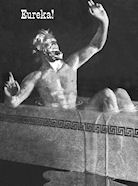
They too, like the original commentator, are surprised by, albeit excited about, the fact that Archimedes plays from the start. Archimedes minor soccer demonstration prior to the game
(0.55-0.59 in the video), in which he nomadologically traces a neverending line of the ball while juggling, is probably what gets them started:

There is a kind of science, or treatment of science, that seems very difficult to classify, whose history is even difficult to follow. What we are referring to are not "technologies" in the usual sense of the term. But neither are they "sciences" in the royal or legal sense established by history. According to a recent book by Michel Serres, both the atomic physics of Democritus and Lucretius and the geometry of Archimedes are marked by it. The characteristics of this kind of eccentric science would seem to be the following:

1. First of all, it uses a hydraulic model, rather than being a theory of solids treating fluids as a special case; ancient atomism is inseparable from flows, and flux is reality itself, or consistency.

2. The model in question is one of becoming and heterogeneity, as opposed to the stable, the eternal, the identical, the constant. It is a "paradox" to make becoming itself a model, and no longer a secondary characteristic, a copy; in the Timaeus, Plato raises this possibility, but only in order to exclude it and conjure it away in the name of royal science. By contrast, in atomism, just such a model of heterogeneity, and of passage or becoming in the heterogeneous, is furnished by the famed declination of the atom. The clinamen, as the minimum angle, has meaning only between a straight line and a curve, the curve and its tangent, and constitutes the original curvature of the movement of the atom. The clinamen is the smallest angle by which an atom deviates from a straight path. It is a passage to the limit, an exhaustion, a paradoxical "exhaustive" model. The same applies to Archimedean geometry, in which the straight line, defined as "the shortest path between two points," is just a way of defining the length of a curve in a predifferential calculus.

3. One no longer goes from the straight line to its parallels, in a lamellar or laminar flow, but from a curvilinear declination to the formation of spirals and vortices on an inclined plane: the greatest slope for the smallest angle. From turba to turbo: in other words, from bands or packs of atoms to the great vortical organizations. The model is a vortical one; it operates in an open space throughout which things-flows are distributed, rather than plotting out a closed space for linear and solid things. It is the difference between a smooth (vectorial, projective, or topological) space and a striated (metric) space: in the first case "space is occupied without being counted," and in the second case "space is counted in order to be occupied."

4. Finally, the model is problematic, rather than theorematic: figures are considered only from the viewpoint of the affections that befall them: sections, ablations, adjunctions, projections. One does not go by specific differences from a genus to its species, or by deduction from a stable essence to the properties deriving from it, but rather from a problem to the accidents that condition and resolve it. This involves all kinds of deformations, transmutations, passages to the limit, operations in which each figure designates an "event" much more than an essence; the square no longer exists independently of a quadrature, the cube of a cubature, the straight line of a rectification. Whereas the theorem belongs to the rational order, the problem is affective and is inseparable from the metamorphoses, generations, and creations within science itself. Despite what Gabriel Marcel may say, the problem is not an "obstacle"; it is the surpassing of the obstacle, a pro-jection, in other words, a war machine. All of this movement is what royal science is striving to limit when it reduces as much as possible the range of the "problem-element" and subordinates it to the "theorem-element."
It bothers Deleuze and Guattari, as much as it bothers Serres, that Socrates gets the last word again (3.00 in the video). Serres (The Parasite, p. 251) mingles into the discussion and states that:

Socrates gets out unscathed. His beautiful individuation is different and evil. Ugly and evil. He runs to take care of his individuation in the gymnasium. To make it flexible, to clean it, to make it effective.

Whereas the other offensive Greeks -- Democritus, Heraclite, and Archimedes -- are atomists (and therefore hydraulic, minor, flux-oriented thinkers), Socrates thinks but of one thing, that is, putting the nail in the coffin. He does so with his head (of course!) and with the German net, two things, that arborescent thinkers have used
to freeze atomistic flux ever since; to stabilize essence in 'statuelike concepts' (Serres, Conversations).

Yes, Deleuze and Guattari continue, the 'apparatus of capture' of Royal Science and State philosophers - always parasiting the benefits of atomism and nomadic war machines!

Mm, Serres (Conversations, p. 105) concurs, 'The mean player imagines himself to be a subject by imagining the ball to be an object – the sign of a bad philosopher'.

After a moment of silence, a time-space filled by the disturbing noise of vuvuzelas, Deleuze and Guattari, who have run out of steam philosophically, angrily rush up from their chairs and ostensively swarm out of the edifice. Serres (
Conversations p. 23), still evaluating the events, finally -- with a smile on his face -- concludes:

I have always been a hellenist.


2/15/11

Holey diver

Holy Diver
You've been down too long in the midnight sea
Oh what's becoming of me - DIO


Hill Taylor stunned the world by breaking the world-record in backstroke 50 m in a minor championship. His performance was also a baptism, in which the name dolphin-man was lent to him.

Dolphin-man is the fastest in the contest, and, with regards to the distance backstroke 50 m, even in the world. But he cannot win, and he knows that. It all depends on his maneuvre of preference, the dolphin-kick. The excellence by which he wields this powerful weapon is the key to his total domination. This move is not essentially illegitimate in backstroke, only so when it emerges in certain proportions. A swimmer must return to air after fifteen metres, lest he's to be disqualified.


Consequently, backstroke 50 m should be named "backstroke more than or equal to 35 to less than or equal to 50 m". Given this, one cannot practically be a record-holder in backstroke 50 m! If you on the one-hand swim using regular backstrokes (think paddle-wheels on steamboats), your opponents will leave you behind as fast as dolphins ward off a shark attack. On the other hand, if you, like the dolphin-man, multiplicate the efficient dolphin-kick, your result is not qualified. That he aggregates a legitimate gesture at least qualifies him as minor athlete.

Practically, no one can be said to hold the world-record in this aquatic event, since what's measured is fuzzy. A fuzziness whose depth dolphin-man delves into. Almost like what D&G hold as the ideal stance in minor science, it is both the "backstrokeness" and "50 metresness" of backstroke 50 m that dolphin-man examines in this race. Albeit in a bigger bathtub, and with an euresqueeeeka, dolphin-man's performance appears as an Archimedean event.


Reading the work of Peter Sloterdijk incites us to ask strange questions. For example, can man become an aquatic being again? Is it possible for a human being to dive into the water not to drown there but to take up with dolphins and mermaids? Are we able to switch elements like this? (...) Sloterdijk's focus on the elements air and water is meant to counteract the age-old philosophical tendency to prioritise earth and fire. (...) It is true, philosophy started with a notorious claim about water. Thales of Miletus (624-545 BC) argued that it was no less than the basic principle (arche) of everything, but subsequent philosophers have done everything to stash away Thales's proposition. How, after all, could one base the world on something fluid? So, philosophy forgot about its own beginnings and became a dry exercise. (...) Almost all anthropology is suffering from a mono-elementary bias. It interprets us as creatures who in the end can only exist in one element, that is to say, on the mainland, in the so-called real. - Rene ten Bos, Towards an amphibious antropology, Environment and Planning D: Society and Space 2009, volume 27, pages 73-86.
The dolphin-man proves to be a fine specimen of the variety of conceptual athletes, by way of which the poet John Keats demonstrates the essence of poetry for his adept-lover Fanny Brawne in the movie Bright Star:
A poem needs understanding through the senses. The point of diving in a lake is not immediately to swim to the shore; it's to be in the lake, to luxuriate in the sensation of water. You do not work the lake out. It is an experience beyond thought. Poetry soothes and emboldens the soul to accept mystery.
Poetry (poeisis) is equivalent with pro-duction (Agamben), invention (Serres), and virtuosity (Virno). Poeisis just happens and is seldom an effect of a planned scheme; contrary to praxis, which contains in itself the goal, the implementation, and the expected outcome of an act. But doesn't dolphin-man, contrary to Keats' poet-swimmer, immediately swim to the other shore? Isn't dolphin-man rather an example of a teleological thinking devoid of all means and process? No. He demonstrates that speed is of the essence, not in order to win, but in order to be able to discern problems just before they gel. To gel is the same as being devoured by that great monstrosity that strives to capture all lines of flight: spectacle. Investigate into fuzziness instead! Dolphin-man will lead us past Leviathan.

During movement, the dolphin-man never leaves the water, which is treason against "the criterion of due humanness in sport".* It's mandatory that the body backstroke-swimmer breaks the surface at least once from underneath. In backstroke man must proof he's a mono-elemental entity by breathing once in a while. Dolphin-man doesn't. Beneath waves events are too furtive to be (made) spectacular.


*This concept will need more unfolding than the initial one, carried out here. "The criterion of due humanness in sport" is a concept that relies on the hypothesis that sport, in order to be sport, must include Latourian-flavoured "trials of humanness". The human factor must be guaranteed and legitimized in sports. When someone runs fast in track and field contests, wind speed must be accounted for in order for the results to be reliable. Testing for doping is legio in contemporary sports. That illegal substances mustn't be found in the athletic body is another example of the criterion of due humanness in sport.

On the one hand, sport is a perfect inversion of the laboratory in which humanness must be quashed, and in which substances are everything. On the other hand, sport is only partly a perfect inversion of the laboratory (at least in Latour's ideal-type of the same): whereas objective measure is celebrated in both laboratories and sports, the former purify nonhumanity from humanness, while the latter purify humanity from nonhumanness.

9/30/10

The moral, molar, or molecular winner of a contest?

In his treatise on fair play, Sigmund Loland repetitively comes back to one formula(tion) of what is produced in sport: the sweet tension of uncertainty of outcome. Michel Serres is of a similar meaning when he states that the 'glorious uncertainty' in sport is that which saves it from being just another crude dialectic scheme, like, for instance, war.

Are there any other practices and structures that produce uncertainty to the degree, and as sweetly, as sports do? Uncertainty, definitely; as sweet, perhaps. Listening to a story, having sex, taking part of, or consuming, artistic improvisation, sure. The list could be expanded, but none of them has this production as a guiding rationale. Due to this, and despite the fact that sport has as its structural goal measuring, comparing, and ranking human beings, Loland is right to emphasize sport as a possible arena for the Aristotelian eudaimonia - human flourishing.

'Generalized athleticism' is but one of Deleuze's (and Guattari's) physical culture concepts that never were elaborated enough with. According to D & G, this modus sprung from, and was established in, ancient Athens, where it contributed to the upbringing of the free men - the vanguards of democracy. In all spheres of life, these men were paradoxically constituted as both friends and rivals. Ideas of justice and equality are foundational pillars of this model. Harsh as it may seem, justice and equality both must be executed, both must have their procedures. Modern sport is probably the societal sphere that has implemented this rationale the most successfully and sufficiently, which the name 'generalized athleticism' also implies.

To compete in sport one will need other competitors, and moreover, their efforts will spur you to perform better. The more equal you are with concerns to performance ability, the more sweet uncertainty you are probable to produce. Friend and rival in one. Cozy contest. Contest is derived from contestare, Latin for 'to strive together'.

So far, so good - in both the dramaturgical, and the literal sense of the expression. Why must 'So far, so good' end? Sport is an autotelic practice with the structural goal of inaugurating a victor, and ranking the tawdry mass of losers behind, and beneath, the laureate(s). At the molar (concentrates of memories and mores - memores?) level winners and losers are produced, and added to history, while at the the molecular (atomistic, micropolitical, and mo/ve/mental) level, the sweet tension of uncertainty of outcome revels and unfolds like the crest of a wave. But does the sweet tension really rely on the uncertainty of outcome?

According to Loland, the (uncertainty of) outcome of a competition is the impetus that renders sport it's dynamics. For certain, Loland applies Caillois's concepts of Agon (contest) and Alea (chance) in his conclusion to support his preferred -- and, it must be added, rigorously accounted for -- moral (molar) imperative of sports: play (with a shared ethos) to win. Portions of Alea may be added to the Agon, that nevertheless always will be the essence of sports. In this line of thinking, outcome, i.e. the zero-sum game of the production of the molar positions of winners and losers, is the key driver in sports, but if uncertainty never emerges, neither will sweet tension .

This box is untouchable; we cannot think outside it, if we, at the same time, want to benefit from its sweetness. But in a good Latourian manner I would like to, at least ephemerally, try to 'extract the honey, and press away the poison' from this equation. So where do I start?

In posts to come, I will argue that outcome, per se, is not a sufficient source for eudaimonia, human flourishing. Such coarse identity politics will only reproduce the anxiety of winners (will I be defeated the next time?), and the anger of losers (next time I'll defeat him/her). And why only strive towards the blooming of humanity; why not post-human flourishing? This kind of point of departure would harmonize with many of the contin(g)ental thinkers, such as Deleuze and his 'molecular' analyses.

7/11/10

Vuvuzuela IV


The one tone the vuvuzela is capable of bringing forth is B♭ (pronounced 'bess' in Swedish). Most of the games in the world cup offered a wall of sound - a cacophony not unlike the biblical swarm of grasshoppers. Some games later the Vuvuzuelan intensity had formed itself, and a rhythm, albeit mono-tonal, was discernible. Making the language of supporters stuttering.

The use of vuvuzelas is a profoundly minor practice - it doesn't disrupt the game like the occasional streaker, or like balloons and other nonhuman actors. Instead it heats up, excites, and changes the game without breaking the rules. Sonorously smoothing out game-space; making it a pitch of intensity. Judges will make bad decisions, players will not be able to communicate verbally.

Vuvuzuelans are parasites in the etymological sense of the word, 'the ones eating next to', something Michel Serres makes us aware of. Surprisingly invisible in the live coverage of the audience (funny hats, face-paintings, and beautiful women is the perennial top-three on the producers' lists), but still painfully present, the Vuvuzuelan people much resemble itchy and scratchy worms in the rectal realm.

The rationale of the Vuvuzuelan side is not to choose sides in the all too crude dialectics of soccer. The Vuvuzuelan people is not interested in winners, losers, and other main players in the dramaturgy of history-making. Vuvuzuela reacts on intensity, or, in lack of it, creates intensity. The Vuvuzuelan parliament, wherein its tawdry micropolitics are acted out, is like a choir in an antique drama: bacchanal, emotional, and with the memory of a goldfish.

For crying out loud: May the Bbt man win!


Vuvuzuela III

vuvuzela2


Is tomorrow the last day of the Vuvuzuelan community? Will the 11th of July be remembered (and squandered) like a Deleuzian event? I hear London locked the doors for Vuvuzuela to the Olympic Games... On the other hand it's been told that they handed out them horns to Minor League players in the US. I guess that you really can feel alright when you hear that music ring... Hit it Mark:

And now you step inside but you don't see too many faces
Comin' in out of the rain you hear the jazz go down
Too much Competition, too many other places
but not too many horns can make that sound
Way on downsouth, way on downsouth London town


6/2/10

The mass-production of losers

Victorious

Victorious

We could be victorious

Once again victorious

One last time victorious

Never again victorious

- Victorious, The Perishers

According to the Norwegian sport sociologist Jan-Ove Tangen, the symbolically generalized medium, i.e. the core rationale of a social system (according to Niklas Luhmann), in sport, is (the inauguration of) the victor. Everything in a sports event boils down to this. The not yet known, although anticipated, winner in an athletic contest is the pivot around which the sport event unfolds.

But, to quote ‘the boss’, what about ‘the wrong side of that line’, what about the losers? On the
dark side of the moon losers regroup in ever increasing numbers. The loser isn’t even correctly named: how could one lose what one never had? Sport as a social system might be mediated through the victor, but the lion’s share of what is produced in it is that vast amount of losers. Sport is nothing other than a mass-production of losers.

A worthy mission, for sure, would be to aestheticize losing, to press away the poison and to extract the honey. One of the first things that appears as urgent is ruling out the element of shame that's connected to loss.


5/24/10

Heels over head, and away!


We might as well say that minor no longer designates specific literatures [sports] but the revolutionary conditions for every literature [sport] within the heart of what is called great (or established) literature [sport]. (Deleuze & Guattari, Kafka: Toward a Minor Literature, p. 18).

A minor sport is not a specific kind of sport, the way sets of sports like risk, adventure, extreme or lifestyle sports lead thought to the extravagancies of for instance board sports. To do a minor sport is rather about a certain stance, or, even better, a series of stances. The foremost (ir)rationale of something minor is, as with most of D & G's concepts, deterritorialization.

Deterritorializing means exciting given categories of identity, making them unstable and opening them up for other possibilities. To deterritorialize is to be(come) revolutionary, but without striving for utopia. So it's not so much about freedom as it is about always having a way out (even from freedom?!). The most frequently recurring Kafka-quote in D&G's treatise of the same, is probably 'Head over heels, and away', an imperative of deterritorialization, and, in any situation, or case, the ideal stance.

Where does this leave (or flee) us in the case of sports? A literal inversion, as the allusion of the heading above implies, of 'head over heels and away', was performed by the Columbian goalkeeper, José René Higuita Zapata, in the friendly game between Columbia and England in 1995. His spectacular 'scorpion kick' definitely widened the range of what's expected of and accepted for soccer goalkeepers.

Perhaps agency could be understood thus; as the possible degree of deviance from subject-positions given by the discourse (or diagram).

5/11/10

Outside sports

While such attempts are deemed to failure, critical physical cultural and sport scholars will always have to try to define and categorize sports; modern competitive sports, lifestyle sports, team sports, extreme sports (what's the opposite?) are just some of the labels that circulate. A definition "could only", as Michel Serres warns Bruno Latour about in their fabulous interview-dialogue, "be sketched out at the risk of freezing it [in this case various kinds of sports] once again into statuelike concepts, operations or verbs, too simplistic and coarse" (p.116). Still we must, in order to operationalize.

Perhaps a micropolitical perspective in this most Deleuzian of centuries is appropriate? Reminiscing Foucault as a friend (of wisdom) and as a theorist, Deleuze thoroughly treats each of the former's books with tender, love and care. According to Deleuze, Foucault, due to his Discipline and Punish, established himself as 'a new cartographer'. Deleuze's reading of Foucault acknowledges that there is no inside, no core, no essence, only outside. What appears as inside (various institutions) is only the result of several outside forces clashing.

It is in general a question of method: instead of moving from an apparent exteriority to an essential 'nucleus of interiority' we must conjure up the illusory interiority in order to restore words and things to their constitutive exteriority. We must even distinguish between several correlative agencies, of which there are at least three. There is first of all the outside which exists as an unformed element of forces.: the latter come from and remain attached to the outside, which stirs up their relations and draws out their diagrams. And then there is the exterior as the area of concrete assemblages, where relations between forces are realized. And lastly there are the forms of exteriority, since the realization takes place in a split or disjunction between two different forms that are exterior to one another and yet share the same assemblages (confinements and interiorizations being only transitory figures on the surface of these forms) (p.43).

In this regard different sports could be categorized in relation to how many and which forms of exteriority they put on display. Most modern competitive sports, for instance, appear as insides due to their affinity with national and international governing bodies, and hence also with the whole chapter in history of nation-states. Newer forms of sports, without IGBs and NGBs with monopoly, like skateboarding, eSports, and parkour are more overtly exterior. The illusionary insides, 'covertly exterior sports', struggle against the outside noise, which threats to reveal the ephemerality of the insides' notions of them being social systems. And it's a worthy struggle. Overtly exterior sports are much more vulnerable to fragmentization (as was the case with Parkour/freerunning, as well as with eSports).

This demonstration, rather than definition, is still dynamic and open for difference and change. Soccer could be more overtly exterior as in schoolyards and beaches, or covertly exterior, as in the upcoming Champion's League final between Inter and Bayern München. Coupled with Deleuze and Guattari's conceptual cluster of territorialization/deterritorialization/reterritorialization, the concepts of outside, exterior, and forms of exteriority, allow for a to and fro movement, specific to each setting. Perhaps via a dromographic account of the micropolitics of the given sport?

Still unanswered, though, is the question: what makes the chimairic insides of covertly exterior sports resemble each other? Could it be boiled down to mere competition? And where, then, does this leave the concept of a minor (and a Major) sport? Plausibly, Major sport is a pure pole, stripped of everything but the competition clause. But this doesn't mean that minor sport is the same as overtly exterior sports.

D & G mean that Kafka created a 'minor literature' in writing, as a jew in Prague, in German. He pushed the language of the German bureaucrats and oppressors to its limit and beyond, in a stuttering kind of way. Minor literature (as well as sport) is an insider practice with an outsider agenda. Outsider, not as in spy or enemy, but as a pure Foucauldian outsider. To become foreign within, be it language, or sports. Think outsidish inside whatever box. In other words: parasitism. A perfect illustration of this is Barbara Fornssler and Sean Smith's treatment of the concept of the 'switch', which they develop in their analysis of the boardercross-athlete Lindsey Jacobellis' famous final, stuttering, race in the Olympic winter games in Turin 2006.