Showing posts with label Breakwaters. Show all posts
Showing posts with label Breakwaters. Show all posts
2/2/11
Boulder rush IV: "A loose boulder"
Contact and contiguity are themselves an active and continuous line of escape. [...] On the one hand, there is a rapid and joyous sliding movement or deterritorialization that makes everything adjacent even at the moment when the dreamer seems to have fallen into an abyss ("The paths there were very winding, ingeniously made and unpractical, but he glided along one of them as if on a rushing stream with unshaken poise and balance"). On the other hand, there are these pathways, these equally rapid segments that bring about deadly reterritorializations of the dreamer [...]. Undoubtedly, this [...] sheds some light in that deadly reterritorialization of K in a hard segment, "a loose boulder".
Deleuze & Guattari, Kafka: Toward a Minor Literature, p. 61.


Bo(u)lder rush III: My, oh My, You need a boulder to cry on!

Nej där fanns ingen lilla My-In The Book of Moomin, Mymble and little My, the two first desperately try to find the third. Just before My decides that she now might be found, the anguished Moomin and Mymble stumbles through a cave populated by humongous boulders. The wind howls hideously (det blåste med ett gräsligt gny), like it often does in passages and upon thresholds (when doors are opened), and the two are anxious to get out as fast as possible. The briefness of the visit to the realm of becoming is justified by the claim that "No, little My was not to be found there" (Nej där fanns ingen lilla My). She there, she there...
det blåste med ett gräsligt gny
det tjöt och drog ur alla vrår
och viftade i mymlans hår
och runt omkring dem, vart man såg,
hemskt stora bummelstenar låg.
De klättrade och kröp bland dem
och Mumintrollet ville hem.
Ack Mymla, sa han, aldrig mer
min mammas hus jag återser!
Fort ut i solskenet igen!
Vad tror du att det hände sen?
Could one not be found(ed) -- exist -- in becoming? A little forced lost in translation -- anti-etymology, ie philosophical lifestyle athleticism (such as surfing) -- might come in handy here.
Boulder comes from the Scandinavian word Buller (Bummel in the verse above) which means noise. Noise, in turn, is a central sense of the word parasite, which acts as exciter and catalyst in relations. Noise is the transductive area, which becomings inhabit - where the wild things are.
Let the shuttle weave back to Swedish, and we'll find that the word for noise is (o)väsen, which also mean entity! One could be found(ed) in becoming! QED! Yes we can!
Therefore:
Being is becoming. Be(com)ing. Essences, substances, definitions are but snapshots and freeze-frames of constant flux. Whatever is of the essence is off the essence, or, rather, the essence of being is becoming. To exist is etymologically derived from standing or coming forth, to get out of a standing position, or of a place.
Running on boulders is awesome! Becoming rulz! Deterritory FTW!!!!
1/25/11
Bo(u)lder rush II: 'the cup that overfloweth'
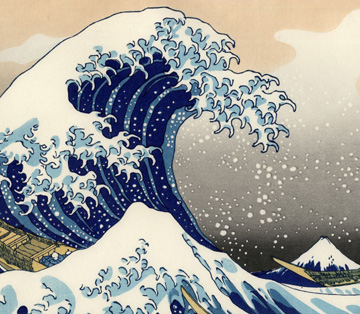
The knife wants to slit you
the sea wants to take you
- The Smiths
Could the world of waves be clarified? In her 'precisions sur les vagues', French writer Marie Darrieussecq investigates into the crests, eddies, and whirlpools of the Atlantic ocean, by which she lives and breathes. Her little treatise is a classic among surfers.
Being a 'follower and deliverer of difference', the surfer is a renowned conceptual athlete in contin(g)ental philosophy (cf Deleuze, Serres, Zizek). Karl Palmås means that what Bergson understood as intuitive thinking -- to merge with, dissolve in, and melt into whatever you are researching -- is motorically and cognitively duplicated in the performance of the surfer.
Running on breakwaters has in a former post been seen as surfing the conceptual (and physical) border between nature and culture. Surfing is always coastal, whether on land or on sea. The bo(u)lder runner is the sibling and symmetrical counterpart of the surfer: both ride noise and both 'eat next to' which is the etymological root of the word parasite.
Instead of waves, I run on coastal cliffs and boulders, the crumbled solidity of which almost appears as a shattered, fragmented statue depicting erosion and man's fear of flux: the froth of the land in its desperate attempt to keep the waters at bay.
Flood. The world is being overflooded right now. People suffer from the rushing waters that nourish them, or as Serres says: the parasited parasites the parasite. Whether or not it is global warming -- in turn an alleged effect of the proliferation of naturalcultural hybrids -- that causes extreme weather phenomena, the blending of the two poles is an old taboo.
HC Andersen's 'The little mermaid' is a tale on that theme, this time with a maritime creature crossing the sacred border (instead of an initial human transgression as in for instance Godzilla). A contemporary version of that story is to be found in Hayao Miyasaki's motion picture 'Ponyo on the cliff by the sea'.
Ponyo is the daughter of Miyamoto, a magician in a submarine -- think captain Nemo cum David Bowie. Once a human, Miyamoto now schemes to desintegrate the destructive and earth-abusing humanity by unleashing the pristine and infathomable powers of the ur-ocean. However, one tiny detail ruins his calculations: the (human?) curiousity of his daughter Brunhilde.
Brunhilde repeatedly tries to escape the sub to reach the surface, and finally succeeds in doing so. Once entering the earthly realm, she encounters a boy, Sosuke, who lives on a house on a steep cliff by the ocean. His father is a captain and his mother works with elderly people. Sosuke adopts the funny little fish as his pet and gives her the name Ponyo.
During the film Ponyo moves to and fro in two aspects: firstly, between anthropomorphic and piscine form (due to licking the blood from, i.e. eating next to, Sosuke's scratch-wound, and thereby healing him), and, secondly, between sea and land. The culmination of her constant metamorphosis is taking place when she accidentally, after being held against her will in her piscine form and in her father's submarine, opens the door to the chamber where her father keeps his magic potions, and where the well of the ur-water happens to be.
The force that begins to flow freely after this incident alters the structure of the universe, and the cataclysmic current of ancient creatures and waters that bursts up against the surface bears Ponyo like a herald of the apocalypse. Her first aim is to find Sosuke, who (in a car driven by his mother) has a hard time trying to get home in the approaching storm (1.00-1.19).
The way Ponyo moves (on) the waves is the exact kind of momentum the bo(u)lder runner tries to catch: swiftly prancing with light feet in order to parry the slight topographical (or in this case, topological) deviations of the surface.
Not only does she run like a bo(u)lder runner, she does it on the surfer's turf, why we in this extraordinary demonstration, for the first time, see a merging between the two.
10/14/10
Bo(u)lder rush I
She walks along the line, where the ocean meets the landLets get practical. That is what contin(g)ental philosophy wants us to do. To live the concepts we cherish as the events they are.
like she is walking on a wire in a circus - Round here, Counting Crows
According to Latour, the nature/culture dichotomy is the most fundamental scaffold of the modern constitution. The emergence of Science (with a capital S) depends immensely on this partition. And along came secularization, industry, urbanism, and democracy. Along came the noise of technology, war, and pollution. This is what it boils down to.
Not that I want go all Heidegger about this; scholars of alternative sport always risk falling into the trap of romanticism. Not that there is anything wrong with 'risk' and 'falling' per se, it's just that many of the statements of adventurous athletes seem to reinforce the nature/culture dichotomy. One face of this particular Janus is the gloomy cubicle-denizen of culture and society, while the other is the vigorous and dionysian hedonist in nature. Hence the partition subsists.
One classical border between nature and culture is the coastline; nature in form of the water is both threat and leisure for the members of mankind. Storms, tidal waves and tsunamis threaten culture and humanity with floods and erosion. Bauman states in Liquid fear that such natural catastrophies mark the beginning of modernity. Due to Sloterdijk, the turbulence of water has filled human societies with such awe, that traditional western metaphysics grounded itself, firmly and solely, on the alleged solidity of land. After all Tellus is called Earth and not Water (even though more than two thirds of our planet is covered with water).
Regarding the practical examination of this border, breakwaters seem like an apt locus to start with. Many cities assemble a vast amount of boulders to protect their coastal areas. Are these placed in nature or culture? Due to the dichotomy they are definitely inbetween. They are the relation between city and sea. Coincidentally the word boulder appears to be derived from the Swedish word bullersten which means 'noisy rock', and noise, as Serres reminds us in The Parasite, could be understood as relation. Breakwaters then seem to be both the symbolical and physical crest of the wave that is natureculture (which is Latours dedichotomized concept), and therefore qualifies as one of those vantage points in which Serres wants to place the philosopher.
I want to ride that crest without falling, neither symbolically, nor physically. Will you follow me out to the rocks? This is 'bo(u)lder rush'; rushing is more peaceful than dashing, and the boldness comes from the impossibility of preparing for the required motion on this fragmented surface.
Subscribe to:
Posts (Atom)